





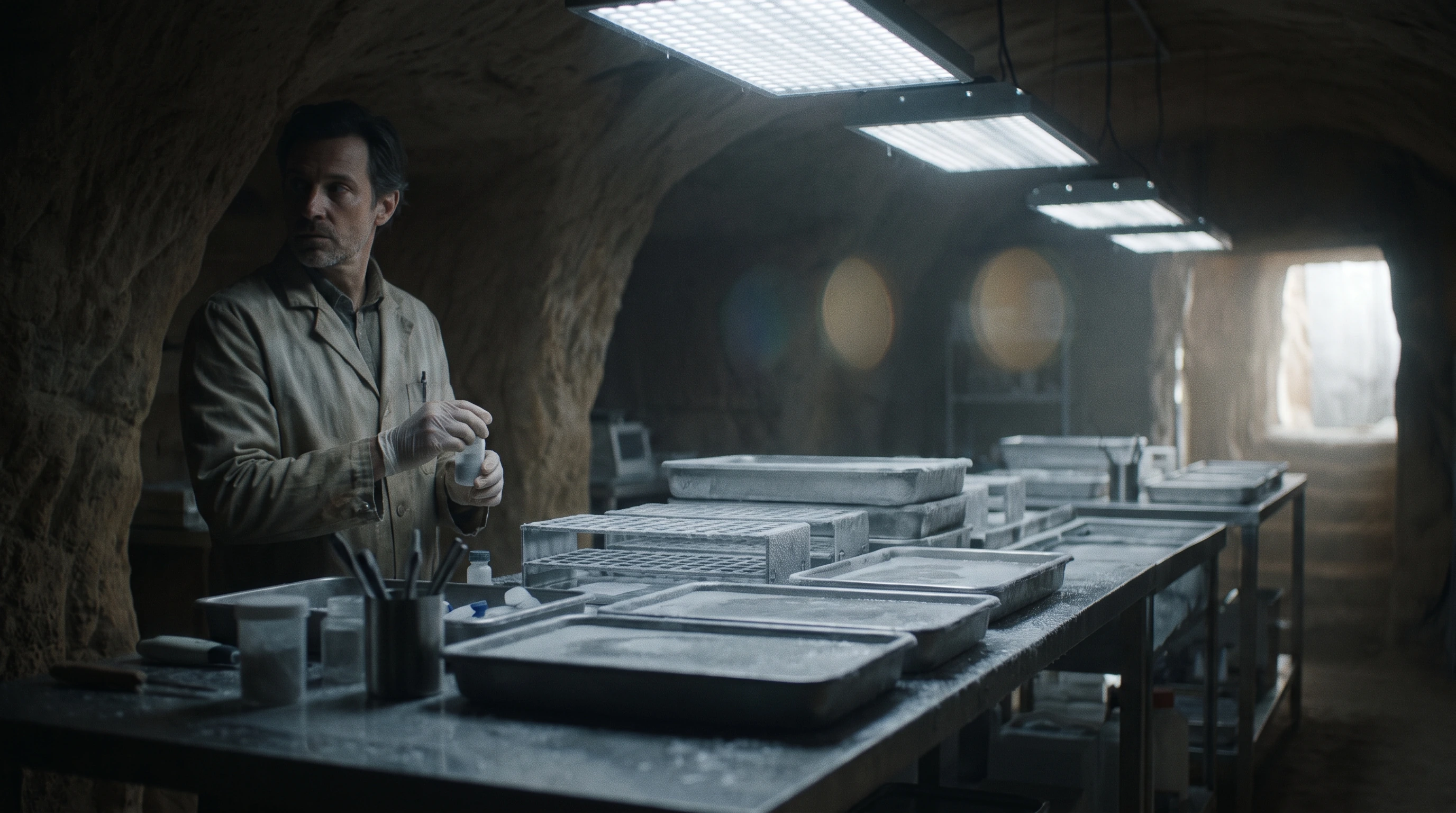
When the world thinks of doomsday shelters it imagines concrete bunkers or steel ships, yet the most vital archive of our food heritage sits 120 metres inside a sandstone mountain on Svalbard, a remote Norwegian archipelago. The Global Seed Vault, opened in February 2008, is not a museum display but a working backup for the thousands of national and regional gene banks that hold the living diversity of wheat, rice, beans and countless other crops (Spacedaily). Its purpose is simple and profound: duplicate the collections stored elsewhere so that a single disaster cannot erase a nation’s agricultural memory.
The vault is a partnership between the Norwegian government, the Nordic Genetic Resource Centre (NordGen) and the Crop Trust, a body created by the United Nations Food and Agriculture Organisation and the CGIAR consortium in 2004. Together they have built a climate-controlled chamber that can hold up to 4.5 million distinct seed samples, each packet typically containing around five hundred seeds. As of mid-2026 the vault stores more than 1.4 million samples, a figure that continues to grow with each quarterly deposit (Seedvault No).
The first time the vault was opened to retrieve material was in 2015, when the International Centre for Agricultural Research in the Dry Areas (ICARDA) arrived with a request to replace a Syrian collection lost to civil war. The centre had been forced to abandon its genebank near Aleppo, but the duplicate stored in Svalbard allowed scientists to re-grow barley, lentils and other varieties that form the backbone of Middle Eastern agriculture (Ftp Icarda). That episode proved the vault’s value not as a speculative curiosity but as a lifeline for farmers whose fields have been torn up by conflict.
Behind the scenes, the CGIAR network operates a system of regional gene banks that hold the bulk of the material actually used by plant breeders and researchers. These operational repositories, spread across Africa, Asia, the Americas and Europe, are the first point of contact for anyone seeking genetic traits such as drought tolerance or disease resistance. Their work is underpinned by the Svalbard vault, which stores a safety copy of each accession, ensuring that a freezer failure or a flood in Nairobi cannot erase years of breeding effort (Croptrust).
National seed banks, however, are not uniformly robust. The United Kingdom’s Millennium Seed Bank at Kew enjoys relatively secure funding and state-of-the-art facilities, but many collections in biodiversity-rich nations struggle with inadequate storage, poor documentation and chronic under-investment. Without reliable backups, the loss of a single national collection could mean the disappearance of unique landraces that have adapted to local soils and climates over centuries.
Adding urgency to the vault’s mission is the very climate that preserves it. Rising Arctic temperatures have begun to melt the permafrost that once kept the vault at a stable-18 °C without heavy energy use. Engineers now must install active cooling systems to maintain the required conditions, a costly adaptation that underscores how climate change threatens even the most remote safety nets (Croptrust).
Recent deposits illustrate the vault’s expanding global reach. In June 2026, more than 15,000 new samples arrived, pushing the total past the 1.4 million mark. Among the contributors were Burkina Faso and Niger, making their first deposits with support from the International Treaty’s Benefit Sharing Fund, and Morocco, which added 1,172 drought-hardy seeds through ICARDA (Moroccoworldnews). South Korea’s Rural Development Administration also celebrated the 18th anniversary of its own Asian seed vault, a partner facility that now holds over 336 000 accessions and offers free long-term storage to countries seeking a safety net (Koreapost). These additions broaden the genetic safety net at a time when extreme weather, pest outbreaks and geopolitical instability are accelerating.
The legal framework governing access to these seeds is the International Treaty on Plant Genetic Resources for Food and Agriculture (ITPGRFA). The treaty seeks to balance national sovereignty-allowing countries to retain ownership of their genetic resources - with the collective need for food security. Under its provisions, a country can request a duplicate from the vault, but must agree to share benefits arising from any commercial use, a principle designed to keep the system fair and sustainable.
As the world confronts a future of hotter summers, shifting pest patterns and the spectre of conflict, the Svalbard Global Seed Vault stands as a quiet, frozen promise that the genetic toolkit of humanity will not be lost. It is a reminder that safeguarding food is not a single-nation endeavour but a shared responsibility, written in the language of seeds stored deep beneath an Arctic mountain.
Yum Opinion: The vault’s growing inventory proves that protecting crop diversity is the most pragmatic insurance policy we have against an uncertain tomorrow.