





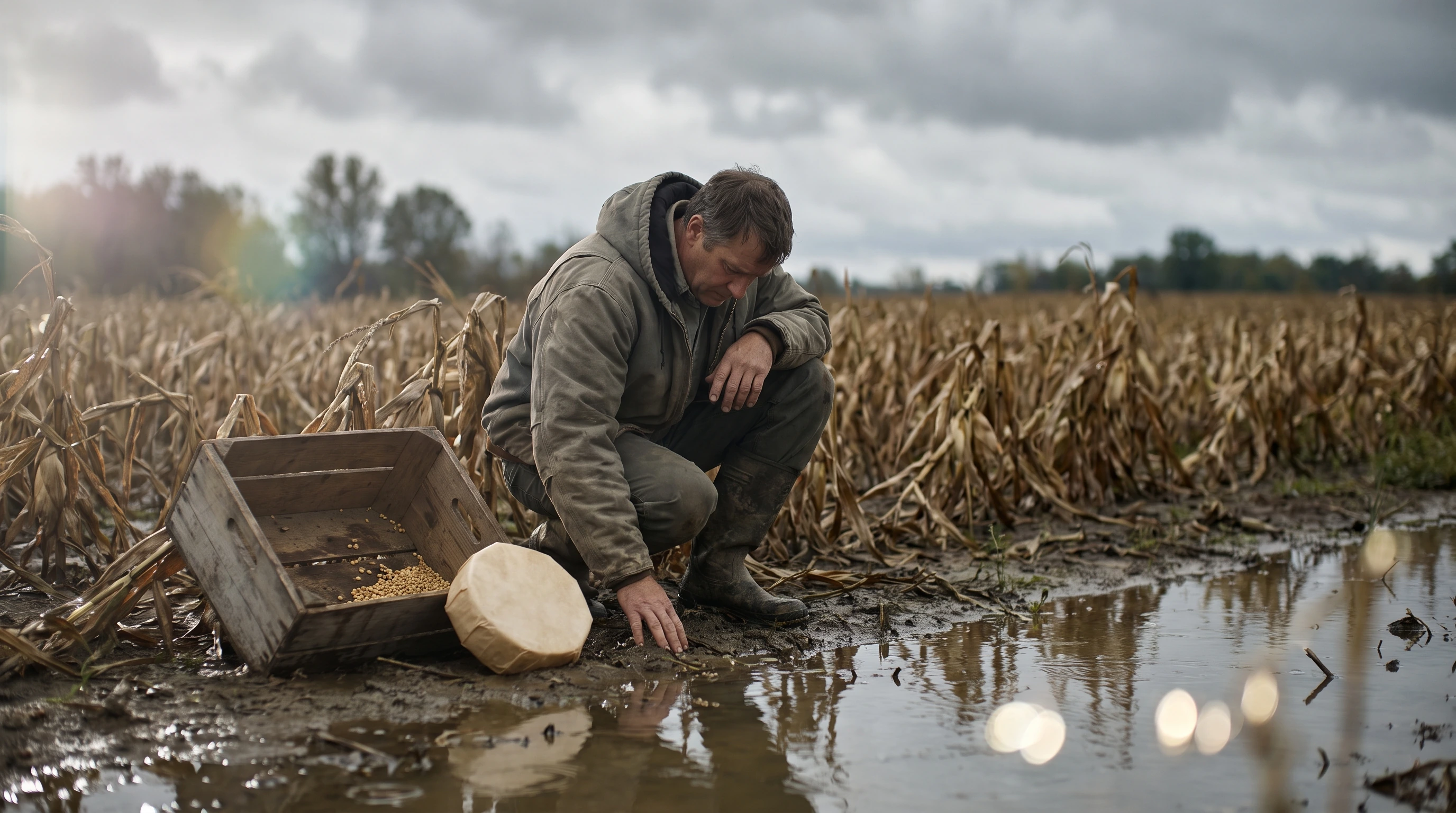
In an Ohio maize field, floodwater covered the ground after days of rain. That plain, human-scale image, a crop standing where the Hocking River had overflowed, captures the difficulty of producing food when familiar seasons become less dependable. Weeks of rain culminated in Ohio State’s Farm Science Review of 22-24 September, where larger field demonstrations were cancelled and cars became trapped in mud. State climatologist Aaron Wilson’s assessment was blunt: the ground could take no more. [2]
Ohio recorded its wettest August in 2026, following its driest August a year earlier. Wilson described the movement between extremely wet and extremely dry conditions as a sign of a changing climate and discussed how farmers could prepare for the extreme weather affecting the state. The contrast matters because harvest is not an abstract endpoint: it depends upon people being able to enter fields, operate machinery and make decisions while the weather continues around them. [2]
One possible response begins below the surface. Scientists are testing deep-rooted soybeans with the aim of improving climate resilience and storing more carbon. The work does not yet warrant grand promises; it is a test rather than a finished answer. Yet its focus is quietly significant. Roots are usually hidden from the people who eventually encounter a crop as food, but researchers are asking whether their depth might help agriculture meet two demands at once: coping better with climate pressure and holding more carbon. [1]
Care for the food journey does not end at harvest. Sierra Nevada Cheese Company recalled all its Graziers grass-fed raw milk cheeses after a multistate outbreak of Shiga toxin-producing E. coli O26:H11 sickened 13 people and hospitalised eight, including one confirmed case in Oregon. The cheese had been sold nationwide, and illnesses began as early as 7 July and continued through 26 August. [3]
These September developments place responsibility at several points along the route to the table. Preparation may mean helping farmers face saturated ground or testing crops whose roots could offer greater resilience; it also means acting when a finished food is linked to illness. None of these measures makes the wider task simple. They do, however, show why attention must travel with food, through the soil, the harvest and the moment a product reaches the public.
The most useful response is neither complacency nor alarm. It is patient work matched to the particular risk: experiments that remain honest about being experiments, practical preparation for extreme conditions, and decisive recalls when safety is at stake. Food may arrive as an everyday object, but the care required along its path is anything but ordinary.
Yum Opinion: I find the most hopeful lesson here is that resilience depends on careful work at every stage, not on a single dramatic solution.