





The old map of food trade still hangs in plenty of executive minds: a few Western capitals, a few legacy fairs, a few familiar routes for buyers, brokers and brands. But the air coming off this month’s exhibition news suggests a harder truth. Procurement no longer has to pass through the same old gates to look global. SIAL Shanghai says intended deals again exceeded RMB 100 billion and drew professionals from 132 countries and regions, then used that momentum to justify a September move into Guangzhou and the Greater Bay Area [1]. On 21 August, meanwhile, International Foodtech Kolkata 2026 opened with an explicit focus on smart and sustainable food technologies [2]. Those are not side notes. They look like signals of a trade geography being reorganised in real time.
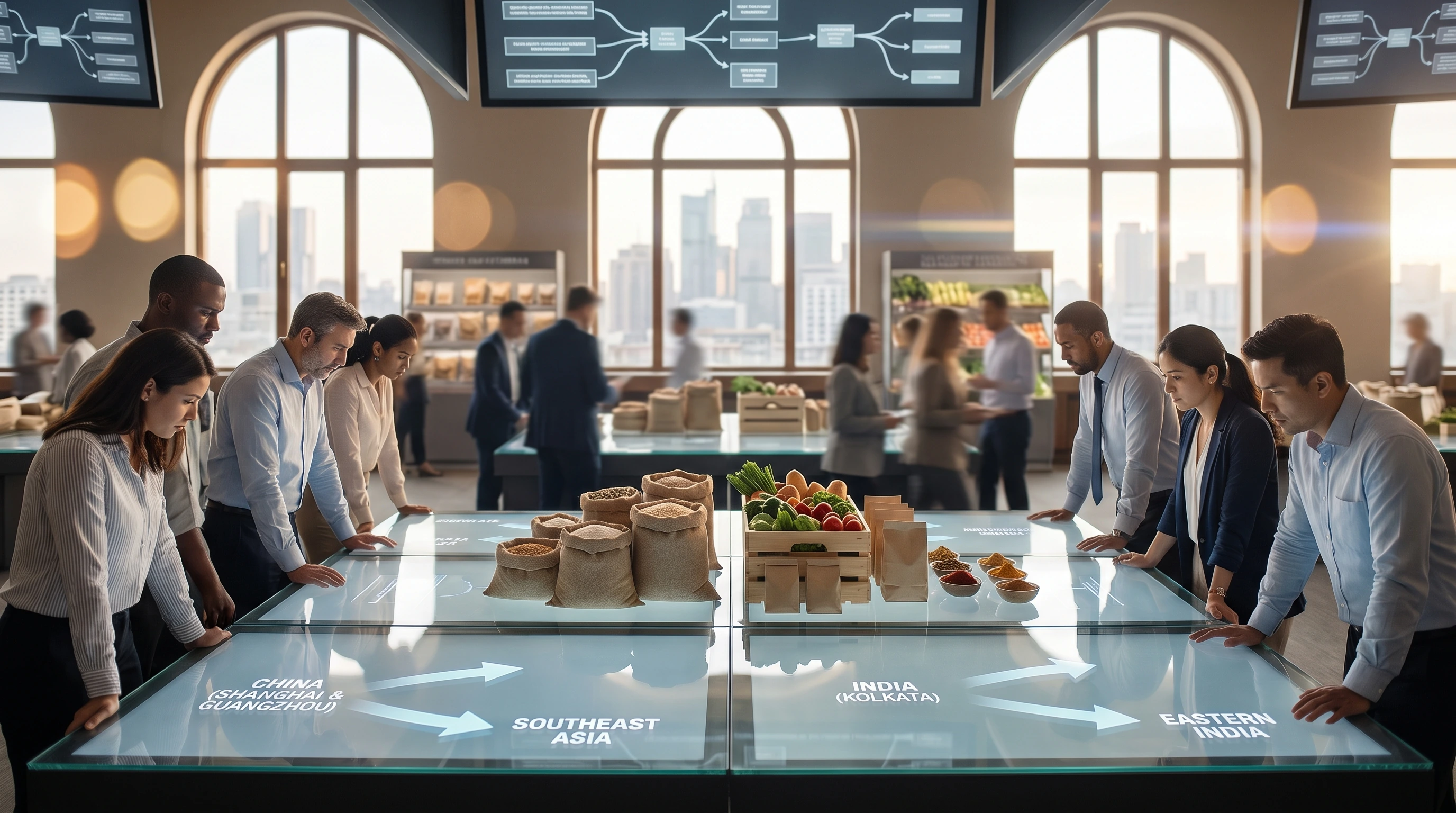
The Shanghai story matters because scale changes behaviour. A fair that can point to more than RMB 100 billion in intended deals is not merely hosting meetings; it is acting as a marketplace with enough gravity to influence where exporters, distributors and retail buyers choose to spend their time [1]. The SIAL summary also sketches the breadth of activity inside that marketplace: bulk orders from multinational buyers, first overseas shipments for regional speciality products, annual contracts with traditional supermarkets and collaborations in emerging channels [1]. Read together, those details imply a procurement network that is no longer built around one type of buyer or one mature retail model. It is broader, faster and more mixed than the old hub-and-spoke version of food trade.
Guangzhou sharpens that shift. SIAL is not simply adding another Chinese date to a calendar; it is moving south to cultivate the Guangdong-Hong Kong-Macao Greater Bay Area and to connect that region to the trillion-RMB Southeast Asian market [1]. That matters because the Greater Bay Area is framed here less as a local destination than as a transfer point between production, distribution and nearby demand [1]. In practical terms, the exhibition circuit starts to do what Western trade hubs long did for the industry: compress distance, create trust at speed and turn regional adjacency into commercial advantage. If Shanghai demonstrates volume, Guangzhou suggests routing logic. Buyers do not need to fly first to a traditional Western centre if a growing share of suppliers, intermediaries and neighbouring markets can be reached more directly in one Asian corridor [1].
Kolkata represents a different but complementary form of leverage. The available summary is narrower, but its emphasis is clear: International Foodtech Kolkata 2026 opened with a focus on smart and sustainable food technologies [2]. That focus matters because procurement networks are shaped not only by where products are sold, but by where the technologies behind processing, efficiency and sustainability are discussed. A show organised around those themes can become a meeting ground for decisions that sit upstream of the supermarket shelf: what equipment is bought, what standards are pursued and which operating models look investable. Eastern India, in that sense, is not just asking for attention as a sales market. It is presenting itself as a place where the future terms of production can be negotiated [2].
The interesting point is that these two exhibition stories do not mirror each other. SIAL’s case is built on proven deal volume, international attendance and a southward expansion tied to the Greater Bay Area and Southeast Asia [1]. Kolkata’s case, at least in the supplied report, is built on the language of smart and sustainable food technologies [2]. One hub says: come here because commerce is already thick. The other says: come here because the next wave of food manufacturing priorities is being organised here. Together they hint at a more layered Asian trade architecture, in which procurement is no longer a single annual pilgrimage to a Western show, but a sequence of regional decisions across demand centres, technology forums and logistics-adjacent cities [1][2].
That does not mean the West disappears. One of the supplied sources is a very different kind of trade signal: a report on Tom Kerridge opening Georgie’s Bar at Corinthia London on 5 September, alongside an evolved version of his existing restaurant [3]. It is not an exhibition story, and it says little directly about B2B food procurement. Yet its presence is instructive. London still generates hospitality headlines and retains symbolic pull [3]. The irritation for legacy hubs is that symbolic pull is not the same thing as being the most efficient place to convene the next generation of buyers, manufacturers and cross-border partners. Attention can remain Western while transactions and industrial conversations become more Asian.
That is why the current news peg matters. In the same week that Kolkata has opened under a smart-and-sustainable banner, SIAL Guangzhou is approaching on 3 to 5 September, backed by the commercial heft of Shanghai’s latest edition [1][2]. The clearer verdict is not that one city or one fair has won. It is that the industry’s map is becoming less obedient to old centres of prestige. Emerging trade hubs in Asia are redefining procurement networks by combining scale, regional access and future-facing technology agendas in places that sit closer to the growth story itself [1][2]. Western hubs may still host launches, bars and reputational theatre [3]. But if buyers increasingly go where the orders, regional links and production debates are densest, then the new geography of food trade is already being written elsewhere.
Yum Opinion: The smarter bet is to watch where deals, logistics and production priorities converge, not where prestige used to live.