






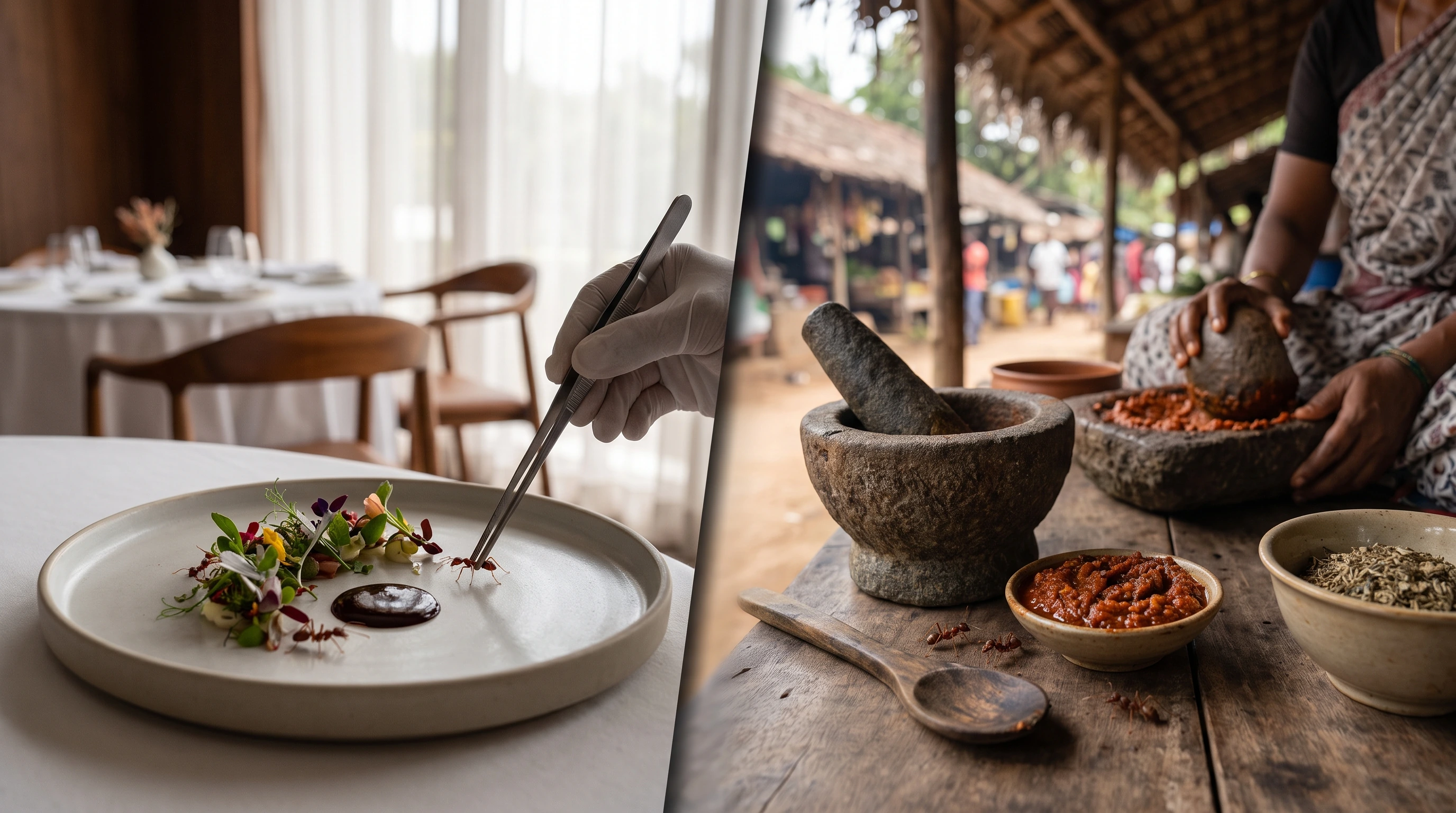
The latest turn in India’s insect story is not really about shock, novelty or dares. It is about status. A food tradition long practised by tribal communities in Chhattisgarh, Jharkhand, Odisha and West Bengal is being recoded for urban diners as something sophisticated, chef-led and menu-worthy, with ants and their eggs appearing in tasting menus and cocktails rather than being dismissed as “survival food”. That is the immediate news peg: an August 23, 2026 report argues that Indian food culture had already made ants edible and meaningful long before fine dining found the right vocabulary for it. The policy question follows quickly behind the culinary one: who gets named, paid and remembered when ancestral knowledge becomes premium gastronomy? [1]
India Today’s account offers an important corrective: ant-based foods were never merely stunts. Red weaver ants and their eggs have long been ground into sour, spicy condiments known as kai chutney, chapra, chapda or hao rit, and their appeal in those communities was tied to nourishment and use, not spectacle. The report describes these preparations as a source of protein, iron, calcium, zinc and vitamin B12, while tribal healers have also used the ants, and a mustard-oil infusion made from them, for ailments ranging from fever and colds to joint pain and poor eyesight. In other words, the ingredient already carried a full social life before chefs reached for plating tweezers or bartenders turned it into a talking point. [1]
That matters because gourmetisation often works by stripping context away first and restoring it later as a marketing flourish. The more flattering version is “discovery”; the more accurate one is frequently delayed recognition. India Today explicitly resists the idea that ants have only now become culturally legible because urban India has approved them. The knowledge sat in plain sight for generations and is only now getting what the report calls its gourmet due. This makes the current moment less a culinary invention than a transfer of prestige from marginalised foodways to high-end spaces that can monetise rarity, terroir and narrative. [1]
The commercial logic extends well beyond India. Mountain View Voice reports that Silicon Valley restaurants and food businesses are embracing insects not as desperation cuisine but as flavour and texture: grasshoppers can add a woody, umami note to a salt rim, while crickets and chapulines are entering snacks and guacamole in ways framed as desirable rather than merely provocative. The detail is geographically distant, yet it reinforces the same market logic. Once insect eating is recast as adventurous, tasty and designable, businesses can sell it to diners who may never have considered the older traditions from which such acceptance draws cultural confidence. That does not make the trend invalid, but it does show how quickly a long-practised food can be detached from the people who normalised it first. [2]
A Helen Clark Foundation discussion paper on New Zealand agritech offers a useful parallel, although it is not about restaurants. It warns that new systems can either displace intergenerational rural knowledge or strengthen it, and sets out recommendations for pushing innovation towards the latter outcome. Applied carefully, that is the right frame for the gourmet insect boom too. The issue is not whether new chefs, founders and menus should touch inherited food knowledge at all. It is whether the business model treats community expertise as extractable raw material or as a continuing source of authority, partnership and value. The distinction sounds abstract until money arrives; then it becomes the whole story. [3]
A better version of the indigenous gourmet pivot would therefore make provenance do real work. That means naming communities as knowledge holders, not simply as colourful backstory; designing supply chains that return income to them; and resisting the urge to describe familiar local foods as newly “discovered” once they cross into metropolitan dining rooms. It also means admitting that taste education did not begin in elite kitchens. Tribal cooks, healers and foragers already solved the core problems of flavour, preparation and use. Contemporary chefs may broaden the audience, but the underlying craft is older than the menu language surrounding it. Innovation is strongest when it extends a lineage rather than laundering it. [1][3]
There is, then, a guardedly optimistic reading of the current moment. If insects can move from stigma to esteem, a door opens for other undervalued food traditions to be treated more seriously too. But prestige is only a win if it travels with attribution and economic inclusion. Otherwise, gourmetisation simply becomes a cleaner, more expensive form of erasure. The worker to follow here is not the celebrity chef but the person whose knowledge made the ingredient usable in the first place. That is the figure who tells us whether this is a respectful culinary expansion or an elegant repackaging of someone else’s inheritance. [1][2][3]
Yum Opinion: The insect fine-dining boom looks most credible when it treats indigenous knowledge as living expertise rather than decorative inspiration.