





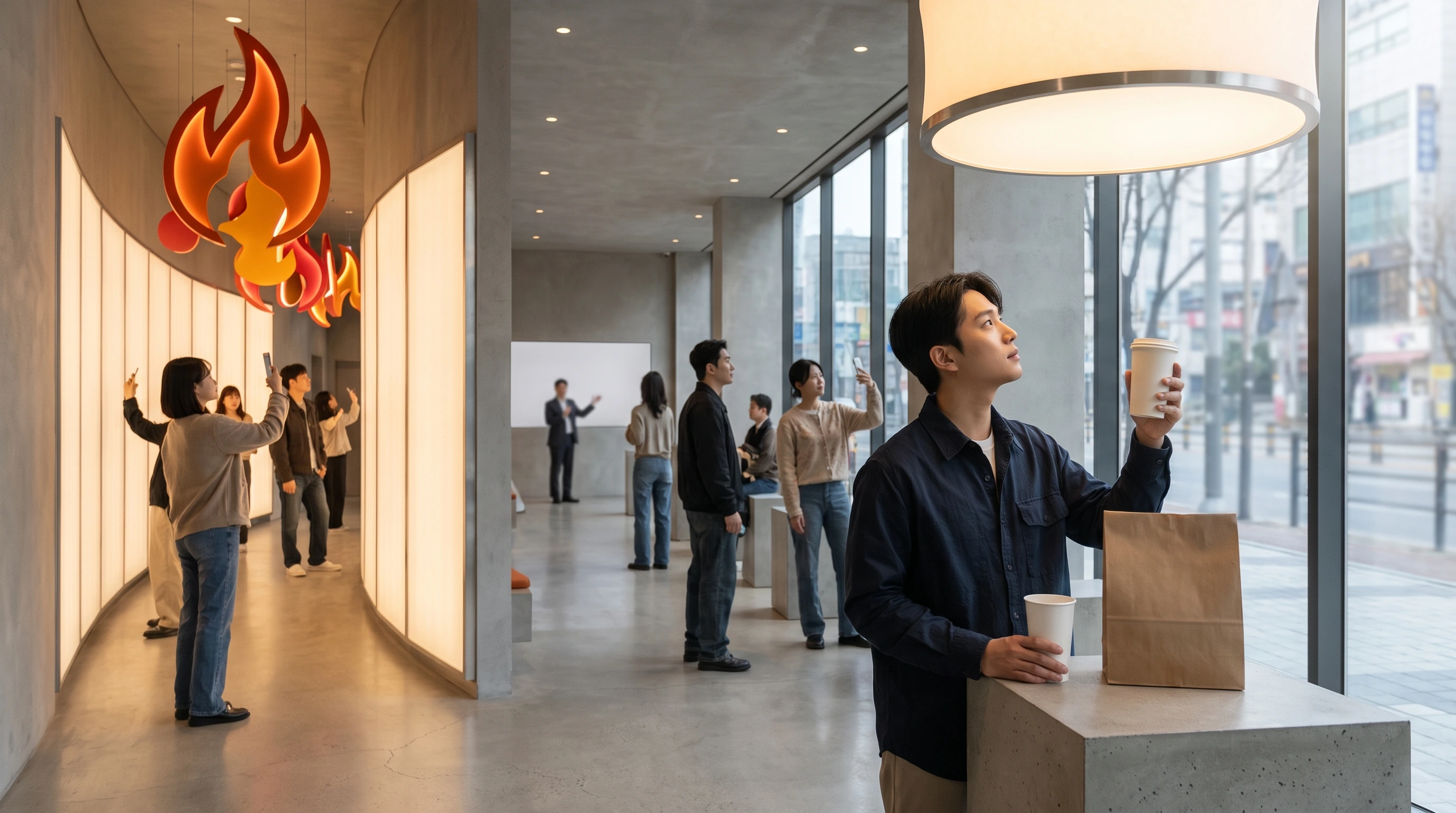
The launch of Burger King’s ‘Flame Ground’ flagship in Seoul gives a timely news peg to a broader shift in hospitality and retail: the point of the flagship is no longer simply to serve quickly, but to declare what a brand believes space can do. The supplied sources do not describe the Seoul site’s design in detail, yet they do show the commercial forces around it. Across food and drink, operators are leaning towards experiences that generate attention, encourage lingering and turn a visit into a cultural event rather than a transaction [1][3].
The clearest sign of that change is the way brands are borrowing languages once associated with fashion, galleries and destination travel. Lindt & Sprüngli’s collaboration with avant-garde designer Joe Ando did not alter the chocolate itself so much as the frame around it: the product was translated into high-fashion dresses to create a buzzworthy consumer experience [1]. That matters beyond confectionery. If a food brand can use couture to enlarge the meaning of a sweet, a fast-food chain can use architecture, art and theatrical circulation to enlarge the meaning of a meal. In both cases, the physical encounter becomes part of the offer.
This is where the flagship diverges from the old fast-food logic of throughput and standardisation. Traditional convenience dining prized frictionless repetition: clear counters, visible menus, quick payment and fast exit. The new flagship logic appears to be almost the reverse. Instead of minimising contact with the environment, it tries to make the environment memorable enough to justify the journey. The venue becomes a manifesto in built form, with corridors, display moments or gallery-style cues doing brand work that signage alone once handled. The lesson suggested by the Lindt example is that sensory surplus is now a commercial instrument, not an indulgence [1].
The second force behind this turn is scale. Maha 2026 in Malaysia is targeting RM8 billion in memorandums of understanding, with around RM4 billion expected from China and 121 agreements lined up across technology transfer, investment, exports and training [2]. Although this is an agriculture and agrotourism exposition rather than a restaurant case study, it shows how food-related commerce is being organised through eventisation, international signalling and place-based experience [2]. That is relevant to flagship dining because it suggests the venue is increasingly expected to function like a live trade fair in miniature: a site for brand diplomacy, proof of ambition and story-rich differentiation, not just a sales point.
The third source sharpens the contrast with pure efficiency models. In Irvine, Keizo Shimamoto’s noodle operation is situated within Smart Kitchens, a multi-concept restaurant space where customers order online and sit at shared tables while food is brought out [3]. That arrangement strips the service encounter down to its most functional elements, and it is revealing precisely because it works. It shows convenience can now be outsourced to digital ordering and flexible back-of-house infrastructure [3]. Once that baseline is secured elsewhere, the flagship is free to pursue another role: not solving speed, but justifying attention. In other words, the more routine convenience becomes, the more premium physical space has to perform emotionally and symbolically.
Seen through that lens, avant-garde architecture is less a decorative flourish than a strategic separation tool. A brand that invests in an immersive flagship can distinguish between two channels at once. One channel handles frictionless fulfilment, whether through app ordering, delivery or modular kitchen formats such as the Smart Kitchens model in Irvine [3]. The other channel handles memory, identity and social visibility, using space itself to make the brand feel larger than the menu. The supplied material therefore points to a split operating model: convenience remains essential, but it is no longer sufficient to carry prestige or cultural relevance on its own [1][3].
There is, however, a tension inside this strategy. Experiences designed as cultural events can create buzz, but buzz is not the same as durable demand. Lindt’s Joe Ando partnership shows how effectively a brand can capture attention by crossing into another creative field [1]. Yet the same example implies a risk for restaurants and fast-food operators: if the spectacle runs ahead of the food, the flagship may read as an expensive campaign rather than a convincing place to return to. The architecture has to do more than photograph well; it must make the act of eating feel newly meaningful, otherwise the destination premium may prove thin [1].
That is why the Seoul launch matters as a marker, even with limited published detail in the supplied context. ‘Flame Ground’ suggests a move away from the anonymous outlet and towards the authored venue, where brand identity is staged through atmosphere and spatial narrative. The broader evidence here indicates that food businesses are increasingly willing to use design, collaboration and event logic to turn premises into statements of intent [1][2]. The question now is not whether convenience is disappearing; it plainly is not. The question is whether consumers will keep rewarding brands for making dining rooms behave like manifestos, especially once the novelty settles and the bill remains real.
Yum Opinion: The flagship boom makes sense as long as the theatre deepens the meal rather than merely distracting from it.