





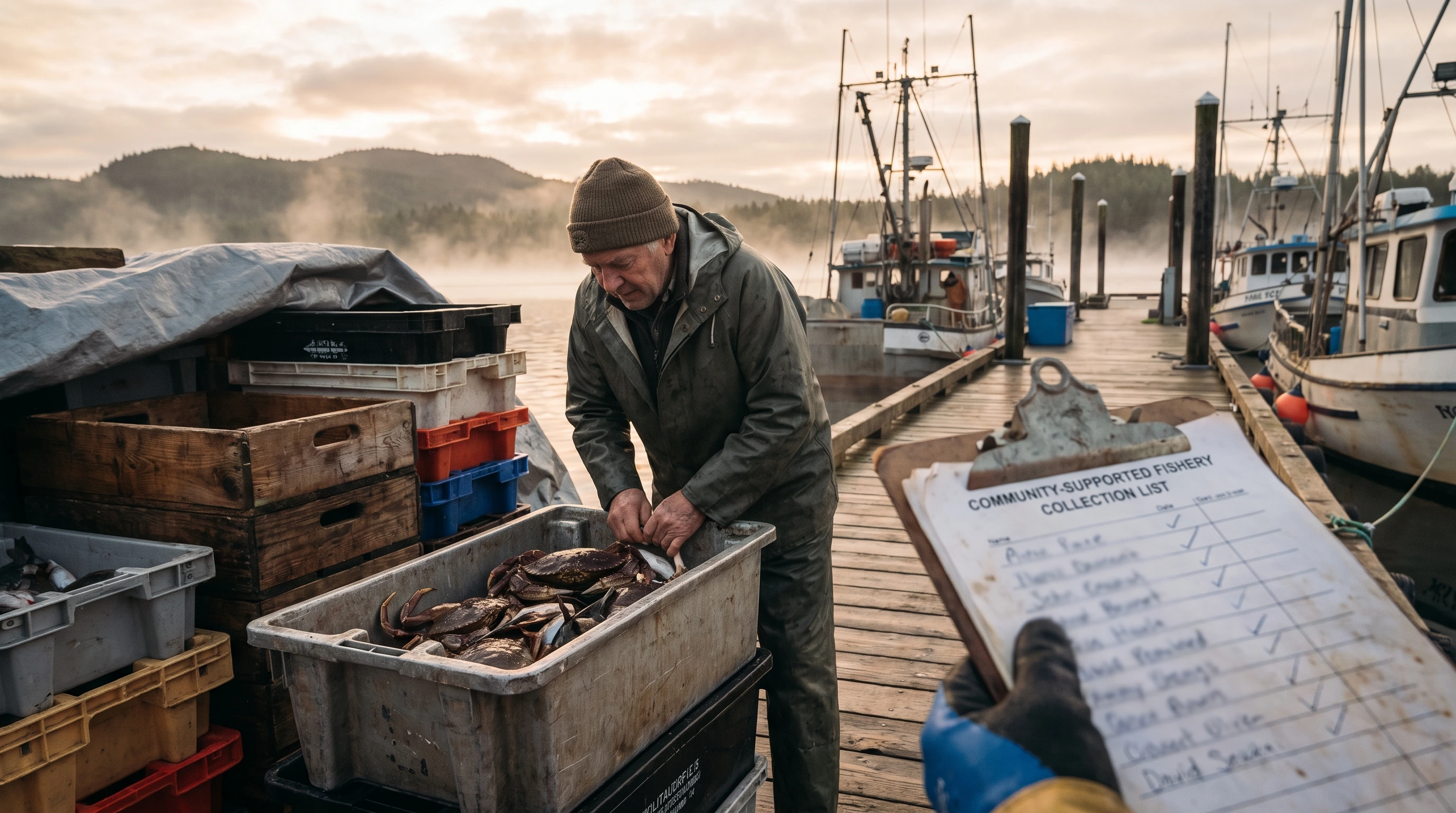
Before a fishing boat leaves the dock, some of its catch may already have a home. At Skipper Otto, members use prepaid credit to choose seafood throughout the year, giving independent harvesters commitments before they set out. What began with one fisher seeking a fair price now connects roughly 70 independent fish harvesters directly with Canadian consumers. [1]
The arrangement belongs to a wider community-supported model in which people pay producers upfront for a share of a future harvest. It is a simple shift in timing, but a meaningful one: the relationship begins with a commitment rather than at the point of sale. For small-scale fisheries, the model offers direct support from members; for those members, it provides a tangible way to put money behind local food production. [2]
That relationship has acquired fresh urgency in Canada. As US tariffs and import bans place pressure on Canadian industries, trade tensions are sending demand for local food higher. Interest in community-supported farms and fisheries is rising, and some farms are reporting double-digit customer growth. [2] [3] The appeal is not presented as an abstract debate about trade. It arrives in a practical decision: paying ahead, then receiving food from producers closer to home.
There is also something quietly human in the model’s origin. Skipper Otto was inspired by fisher Otto Strobel and co-founded by his daughter-in-law, Sonia Strobel, and her husband, Shaun. The business has grown into Canada’s largest community-supported fishery, while retaining the basic idea that prompted it: helping a fisher receive a fair price for a catch. [1] That idea now reaches beyond a single boat, linking dozens of harvesters with members who can select the seafood they want over the course of the year. [2]
The current surge of attention may have been sharpened by tension at the border, but its everyday expression is notably calm. A household commits money; a producer can count that commitment; food travels through a more direct connection between the two. With local demand rising, community-supported food offers Canadians one concrete way to think about food security through the people who grow and harvest what they eat. [3]
Yum Opinion: I like the idea that buying food can begin with a commitment to the person harvesting it, not merely a choice at the counter.