





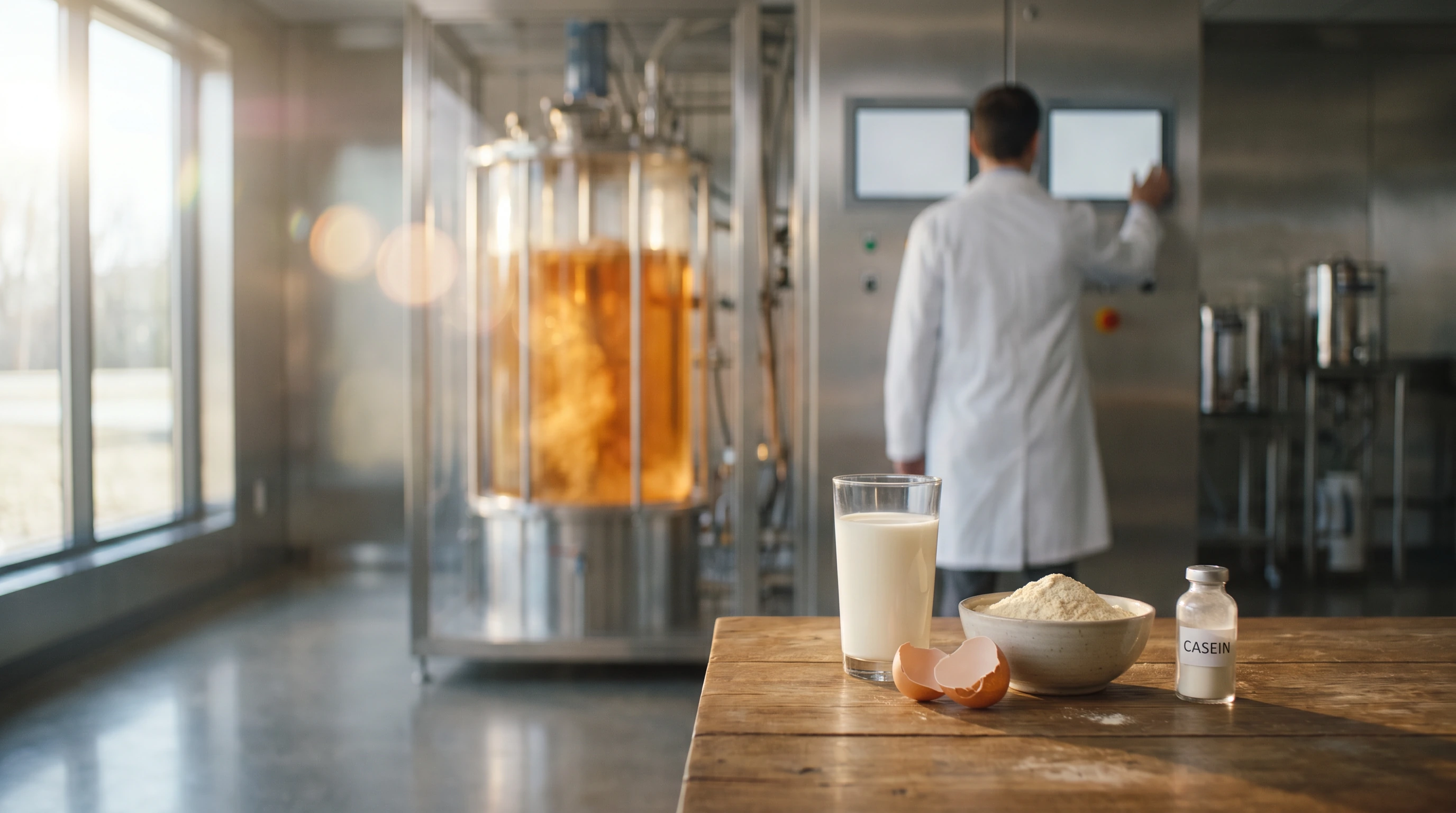
Lorsque vous versez un verre de lait ou fouettez une omelette, il est peu probable que vous imaginiez un réservoir en acier inoxydable qui gronde en arrière-plan, nourri de sucre et de sous-produits industriels. Pourtant, c'est exactement là que la prochaine vague de protéines laitières et d'oeufs est brassée. La fermentation de précision - la pratique de la programmation de levures ou de bactéries pour produire des molécules alimentaires spécifiques - transforme ce qui était autrefois une curiosité de laboratoire en réalité commerciale, les produits apparaissant déjà sur les tablettes de vente au détail en Europe et en Amérique du Nord.
Un des arguments les plus frappants pour la technologie vient de ses références climatiques. Earth911 note que la production d'un kilogramme de protéines de lait conventionnelles peut émettre jusqu'à 72 kg d'équivalent CO2, en grande partie parce que les vaches laitières libèrent du méthane qui est beaucoup plus puissant que le dioxyde de carbone. En revanche, un bioréacteur peut produire la même protéine en utilisant une fraction de cette empreinte, simplement en alimentant les microbes en sucre provenant des flux de déchets. Le résultat est une protéine qui porte les propriétés fonctionnelles du lait sans la charge de gaz de serre de l'animal.
Les innovateurs européens sont à la tête de la charge. La start-up néerlandaise Vivici, une entreprise commune entre Fonterra, géante laitière, et DSM-Firmenich, a obtenu 12,5 millions d'euros du Conseil européen de l'innovation pour étendre ses protéines laitières fermentées avec précision. Le financement aidera l'entreprise à passer de fermenteurs pilotes à des navires de taille industrielle, en tirant parti d'une plate-forme danoise d'ingénierie des contraintes qui stimule le rendement et la pureté. Comme le rapporte AgFunderNews, les progrès rapides de Vivici montrent comment l'expertise laitière établie peut être mariée à la bioproduction moderne pour accélérer l'entrée sur le marché.
AllemagneS Formo prend une voie similaire avec la caséine, la protéine du lait qui donne au fromage son étirement et fondre. Après avoir obtenu le statut de GRAS auto-affirmé aux États-Unis, l'entreprise vise maintenant à commercialiser sa caséine sans vache au niveau mondial. L'approche de Formo, mise en évidence par Greenqueen, met l'accent sur la libération d'acides aminés et l'approvisionnement propre, en plaçant l'ingrédient comme une alternative premium pour les fabricants cherchant la précision fonctionnelle sans les défis logistiques des chaînes d'approvisionnement laitières traditionnelles.
L'effet d'ondulation est déjà en train de remodeler les stratégies d'ingrédients au-delà des remplacements de produits laitiers purs. EDairynews observe un déplacement vers des formulations hybrides qui mélangent des protéines issues de plantes avec des composants laitiers fermentés avec précision. Cette approche multi-sources satisfait les consommateurs flexitaires qui ont soif de goût et de texture familiers tout en maintenant les prix compétitifs. En intégrant la caséine microbienne aux protéines de pois ou d'avoine, les fabricants peuvent affiner les propriétés de fusion, de mousse et d'émulsion, en fournissant des produits qui se sentent et se produisent comme leurs homologues animaux.
Les protéines d'oeufs aussi subissent une révolution silencieuse. La société EVERY, en partenariat avec le fabricant de produits pharmaceutiques Huvepharma, a annoncé une expansion du quadruple de sa capacité de fermentation en Bulgarie, permettant la production en masse d'OvoProTM - la première protéine d'oeuf commercialement disponible fabriquée sans poules. Selon Pharmaceutical Era, l'expansion fait suite à une forte demande de détaillants comme Target et Walmart, soulignant la rapidité avec laquelle le marché accepte ces nouveaux ingrédients.
Pour le cuisinier de tous les jours, le signe le plus visible de ce changement peut être une étiquette que vous ne remarquez jamais. IngrediCheck explique que les ingrédients fermentés de précision apparaissent souvent sous des noms familiers-whey, caséine, heme-sans aucun avertissement spécial. L'hème qui donne à l'impossible Burger sa couleur de viande, par exemple, est produit par la levure conçue avec un gène de soja, fait que la plupart des consommateurs restent ignorants. À mesure que la technologie mûrira, la transparence et l'éducation des consommateurs deviendront aussi importantes que la science elle-même, assurant que la promesse de protéines sans animaux se traduit en confiance sur la plaque.
Avis du Comité: La fermentation de précision transforme les industries laitières et d'oeufs à l'intérieur, offrant la même performance culinaire avec une fraction du coût environnemental - une victoire pour les cuisiniers, les consommateurs et la planète.