





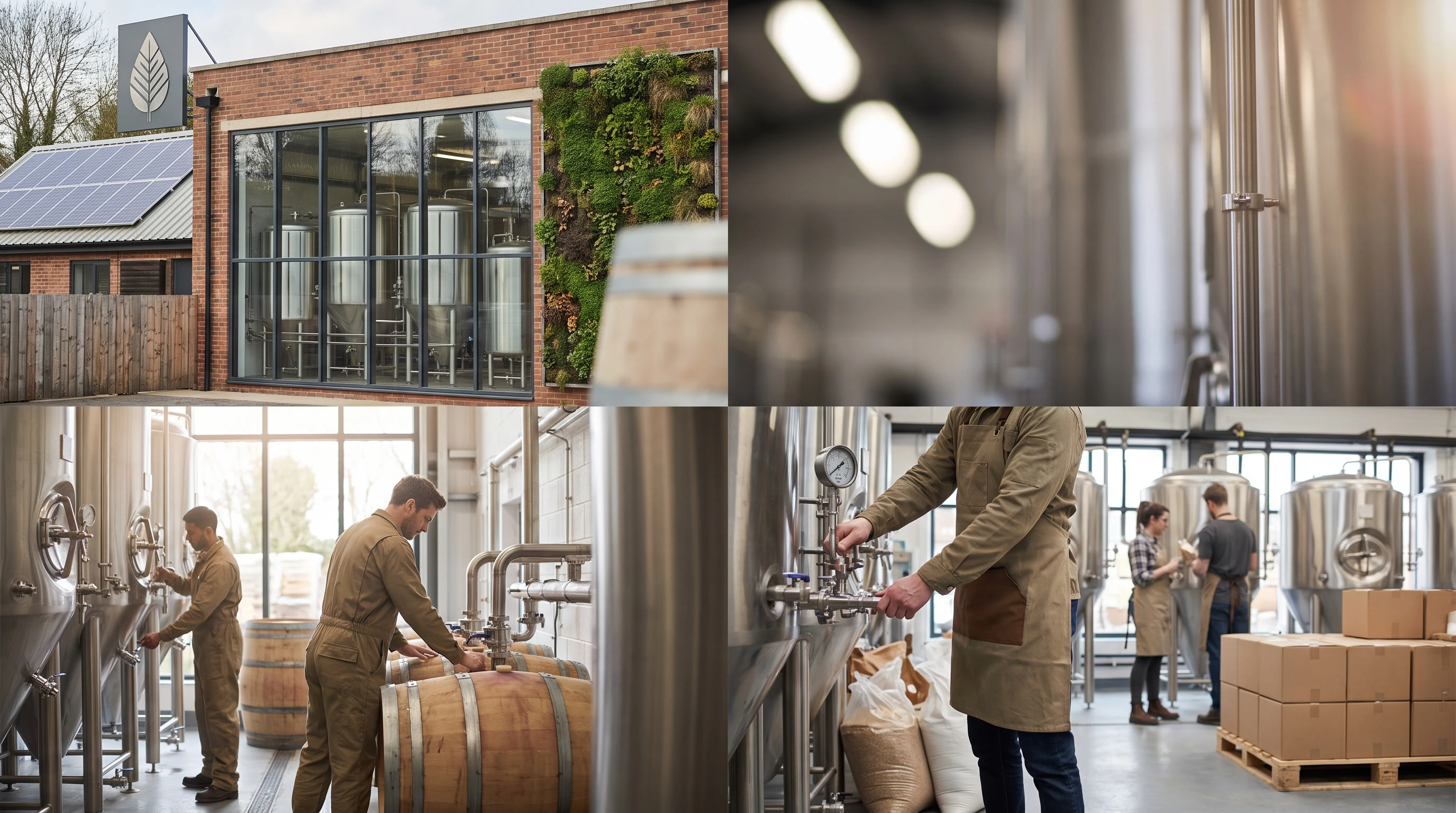
Heineken UK’s £28 million investment in its Manchester brewery is beginning to deliver significant sustainability benefits, with the project almost halving carbon dioxide emissions at the site. The result gives the beverage sector a current, concrete example of decarbonisation tied to a named facility and a defined level of spending [1].
The significance lies in that specificity. A broad environmental ambition can leave open where work will begin and what form it will take. In Manchester, the brewery is the focus, £28 million is the stated investment and lower carbon dioxide emissions are the stated benefit. The claim is substantial but should remain precisely framed: it concerns emissions at this leading UK brewery, rather than Heineken’s entire operation or the brewing industry as a whole [1].
Another initiative extends the decarbonisation focus into dairy ingredients. Barry Callebaut and Arla Foods have launched a three-year collaboration intended to decarbonise the dairy supply chain, beginning with skimmed milk powder [3]. That starting point matters because it turns a wide objective into a bounded programme. It identifies the partners, the initial ingredient and the duration, while leaving the collaboration’s eventual results to be demonstrated over time.
Taken together, the two developments show different stages of action. Heineken’s investment is already beginning to deliver benefits at a brewery; the Barry Callebaut-Arla plan establishes a three-year collaboration and its first area of work [1][3]. They should not be treated as equivalent outcomes. One concerns emerging results from capital committed to a manufacturing site, while the other is an effort focused initially on part of a dairy supply chain.
Product development is moving alongside these environmental initiatives. Recent beverage launches include limited-edition beers, ready-to-drink cocktails, carbonated coffee and functional yerba mate drinks, with new flavours, formats, partnerships and sustainability initiatives among the approaches being used [2]. The range does not prove that sustainability determines purchasing or product success. It does, however, place sustainability within a broader field of beverage activity that also includes flavour, format and collaboration.
The immediate news peg is therefore narrow but useful: a major Manchester brewery investment is now associated with a sharp reduction in site emissions, while Barry Callebaut and Arla have launched a time-limited supply-chain collaboration [1][3]. If such programmes are to carry weight beyond their initial presentation, their value will depend on keeping the boundaries clear: what operation is covered, where work begins and whether the stated benefits have already appeared or remain an ambition.
Yum Opinion: Credible decarbonisation starts with a named target, a defined boundary and results that can be stated without exaggeration.