


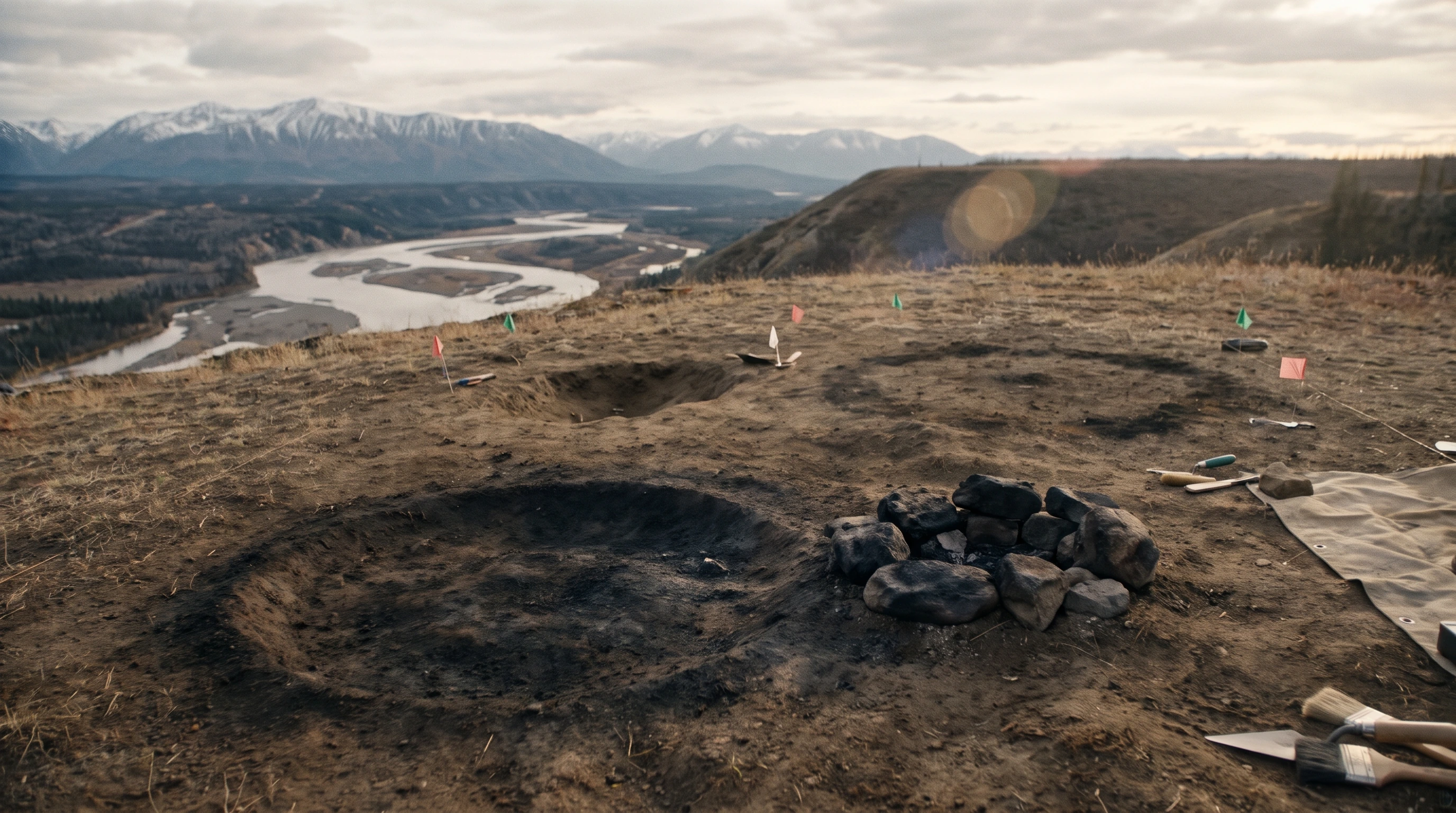

A hearth sits near a dark oval in the soil above Alaska’s Tanana River. Beside it are a shallow pit and the possible trace of a post. The oval, marked by charcoal stains and measuring at least three metres across, may be the remains of an ephemeral dwelling or shelter used about 13,800 years ago at Shég’ Xdaltth’í’ in interior Alaska [1]. No preserved house remains, but the arrangement offers a human-scale possibility: a defined place beside a hearth, made by people living at the far northern edge of a newly inhabited continent.
The interpretation appears in a Science Advances study first published online on 14 October 2026. It concerns the oldest activity layer at a site that has been excavated since 2013 [1]. Other coverage describes the possible dwelling as the oldest yet identified in the Western Hemisphere, while noting a much broader collection of finds: thousands of artefacts and fossils, early needles, stone tools and bones that may belong to the earliest domesticated dogs in the Americas [2]. Each object adds another point to the outline, though the possible shelter itself remains an inference drawn from the ground.
Shég’ Xdaltth’í’ means “They Were There” in an Alaska Native Athabascan language. The site lies about 34 miles, or 55 kilometres, south-east of Fairbanks, within eastern Beringia, the region that connected north-east Asia and north-west North America during the last ice age [2]. Archaeologists describe an encampment used intermittently for a millennium by some of North America’s first settlers [2]. Three early occupations have been dated to roughly 13,800, 13,000 and 12,700 years ago [3].
That repeated use makes the small ridge overlooking the river especially compelling. Rather than a single, isolated mark, it holds traces from different moments of late-glacial life. The site has been presented as a base camp, and its sequence offers an unusually detailed view of hunter-gatherer life in Beringia [3]. The hearth should not be made to tell us more than it can: the available account does not identify what, if anything, was prepared there. Yet its position beside the oval feature matters. It places a familiar focus of camp life next to a possible boundary of shelter.
The latest study’s quiet power lies in scale. A three-metre stain, a pit and a possible post trace are slight remains from which to consider a profound act: making a temporary place to stay, then leaving marks that survived for nearly fourteen millennia. At Shég’ Xdaltth’í’, “They Were There” is more than a resonant name. It is a careful description of what the soil, with appropriate caution, now allows us to see.
Yum Opinion: I find the modest scale of these traces inspiring: sometimes a hearth and a faint boundary are enough to bring ancient lives a little closer.