





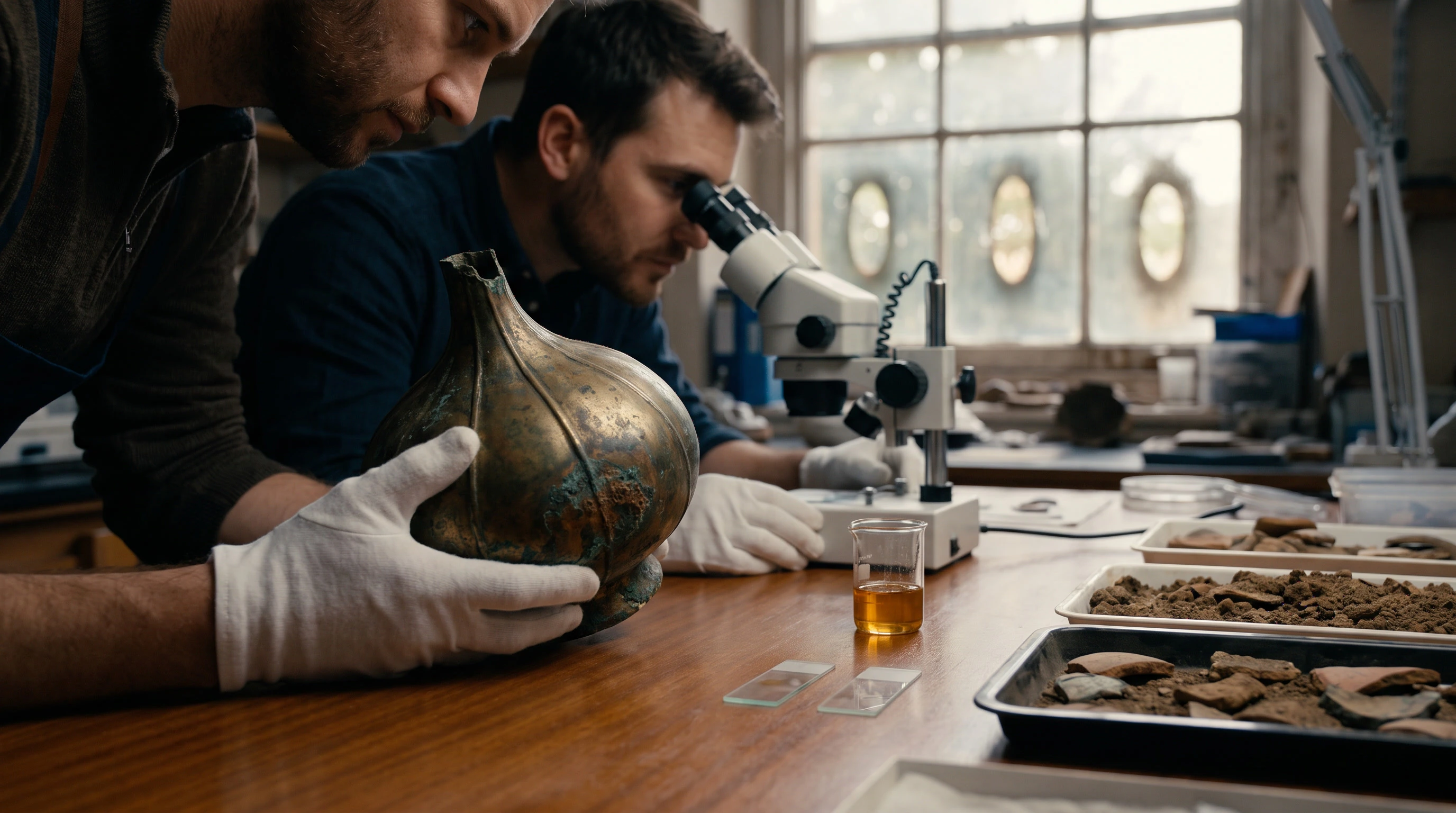
For years, residue archaeology has worked like forensic reconstruction after the feast is over: a film on ceramic, a trace in soil, a chemical signature left clinging to a vessel wall. The quiet reversal in Ningxia is that archaeologists are no longer reading only the after-image. In the latest case, they are dealing with liquid that survived in a sealed bronze pot for more than two millennia, with the broader source context framing the find as 3.7 litres of 2,200-year-old grain wine from a Qin tomb. That changes the scale of the question from “what was once here?” to “what, exactly, remained drinkable enough to analyse as a beverage?” [1]
Xinhua’s account makes clear why the discovery matters. Chinese archaeologists and scientists jointly identified the preserved liquid residue as grain wine made from millet and barley and dated it to the Warring States Period. The vessel itself was a well-preserved bronze garlic-head-shaped pot from the Shanjiabu cemetery of the Qin State in Guyuan, near a Great Wall section built by Qin, and the wider cemetery had yielded 183 tombs as of 2024. The point is not only antiquity. It is that a sealed container preserved enough material to let modern microscopy and chemical work speak with much greater confidence about both ingredients and historical practice than a faint residue alone usually permits. [1]
That is the real turning point. Residue analysis has long been powerful because it can reveal that fermentation happened at all, or that a vessel once carried a particular class of food or drink. But intact liquid pushes the field closer to process history. If researchers can test surviving volume rather than scrape a remnant, they can ask sharper questions about grain choices, preservation conditions and the relationship between vessel design and long-term stability. In this case, the survival of millet-and-barley wine inside bronze suggests that prehistoric fermentation knowledge should be understood not just as an abstract capacity to brew, but as a practical system of making, sealing and storing liquids in ways that could endure extraordinary spans of time. [1]
A second supplied source, while not about archaeology, helps explain why this matters beyond the trench. Fiinews describes the European Union’s Anuga Select India 2026 pavilion as a showcase for quality, authenticity, food safety, traceability, sustainability and innovation in food systems. Those are modern commercial terms, but they echo the same appetite now shaping heritage science: not merely whether something is old, but whether it can be identified, sourced and interpreted with defensible precision. The difference is that archaeology is applying those expectations retrospectively, using laboratory tools to recover a chain of evidence that ancient producers never expected anyone to audit. [2]
The supplied comparison from Utah shows how unusual full-liquid finds remain, even in much more recent contexts. Park Record reports that a bottle from roughly 1870 to 1890, discovered during excavation linked to a construction project at Alta, was notable because it was still full and still corked, with state archaeologists calling it a real treasure and describing a full bottle of alcohol as unheard of. If a sealed alcohol bottle from around 150 years ago can still astonish investigators, then a potable-volume survival from more than 2,000 years ago belongs to a far narrower class of evidence. That rarity is precisely why intact liquids can reshape debates that residue traces only partially settled. [3]
There is also a methodological lesson here. Once a discipline can pair archaeological context with microscopy and chemical identification on surviving liquid, it gains a more integrated record of past drinking cultures. Instead of inferring a beverage from the memory it left behind, researchers can connect vessel form, burial environment, grain composition and preservation outcome in one evidential chain. That does not mean certainty about flavour, ritual use or everyday consumption; the supplied material does not go that far. But it does mean that prehistoric fermentation can be discussed less as a speculative culinary shadow and more as a material technology with ingredients, containers and storage logics that modern science can test directly. [1][3]
The current-news peg is therefore larger than a striking tomb anecdote. The Qin discovery indicates that the frontier in ancient beverage research is moving from identifying residues to recovering systems: how liquids were brewed, enclosed, protected and legible across centuries. As more laboratories acquire the tools to verify contents at microscopic and chemical levels, the commercial value of authenticated heritage drinks, museum collaborations and prestige tasting narratives may rise with them. The catch is that scarcity will set the price. Full ancient liquids are not becoming common; they are becoming more meaningful each time one survives long enough to be read. [1][2][3]
Yum Opinion: The most important shift is not that ancient alcohol survived, but that science can now treat surviving liquid as a system of evidence rather than a curiosity.