

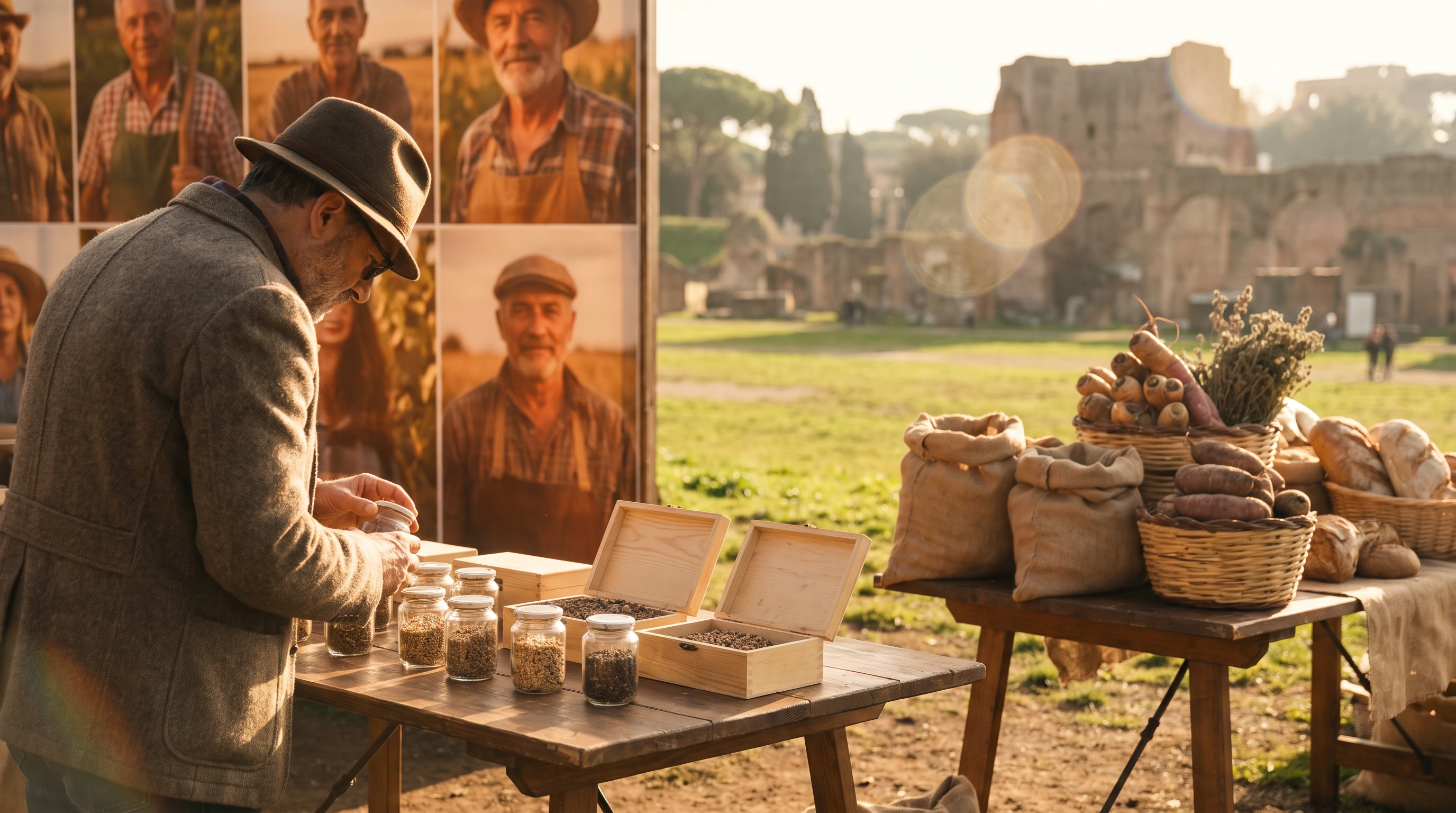
At Rome’s Circo Massimo, an ancient arena has been given a new task: helping visitors consider how food moves from seed to table. From 8 to 12 October, the second FAO “From Seeds to Foods” global exhibition offered free public entry and brought 400 agricultural products, technologies and innovations into a place once associated with chariot racing and vast crowds. Its theme placed innovation firmly in the service of food security and nutrition, with FAO Director-General Qu Dongyu calling for solutions that are practical and affordable.[1]
That emphasis matters because innovation can sound distant until it is connected to the people doing the work. Opposite the exhibition’s Main Stage, the EBRD/FAO “Portraits of Food Heritage” installation used images and personal stories to celebrate farmers, processors and innovators. The people represented sustain food systems while safeguarding traditions passed through generations, making heritage something living: a connection between past and present rather than a display sealed behind glass.[2]
The setting strengthens that idea. Circo Massimo brings a long human history into contact with present questions about producing nutritious food. Yet the exhibition’s focus is not novelty for novelty’s sake. Products and technologies sit within a wider journey shaped by knowledge and collaboration, and the stated ambition is transformation across agrifood systems. In that frame, progress can include what has been carried forward as well as what has only recently been devised.[1][2]
A similar sense of food as a public gathering was due to animate Llangollen on 10 and 11 October. More than 10,000 people were expected at its food festival, where over 100 stalls, 22 local music acts and cooking demonstrations at Blas Culinary School would fill the weekend. With town-centre parking under pressure, Llangollen Railway encouraged visitors to arrive on five services in each direction each day, travelling through the Dee Valley aboard alternating steam and heritage-diesel trains.[3]
Rome and Llangollen offer different scales, but each puts food within reach of an audience rather than treating it as an abstract system. One invites visitors to follow the route from seeds to foods and meet the human inheritance within it; the other gathers stalls, cooks, musicians and travellers in a Welsh town. Their practical details are part of their appeal: free entry in Rome, demonstrations in Llangollen and rail services intended to ease a busy arrival.[1][2][3]
There is modest hope in that openness. Food security, nutrition and agricultural change are formidable subjects, but a public exhibition can give them recognisable faces, while a festival can make participation as ordinary as boarding a train. Neither occasion needs to promise that every problem will be solved. It is enough to create room for people to look more closely at how food is grown, carried, prepared and remembered, and at who keeps that journey moving.
Yum Opinion: I like the idea that useful food innovation can honour inherited knowledge while remaining open and understandable to the public.