


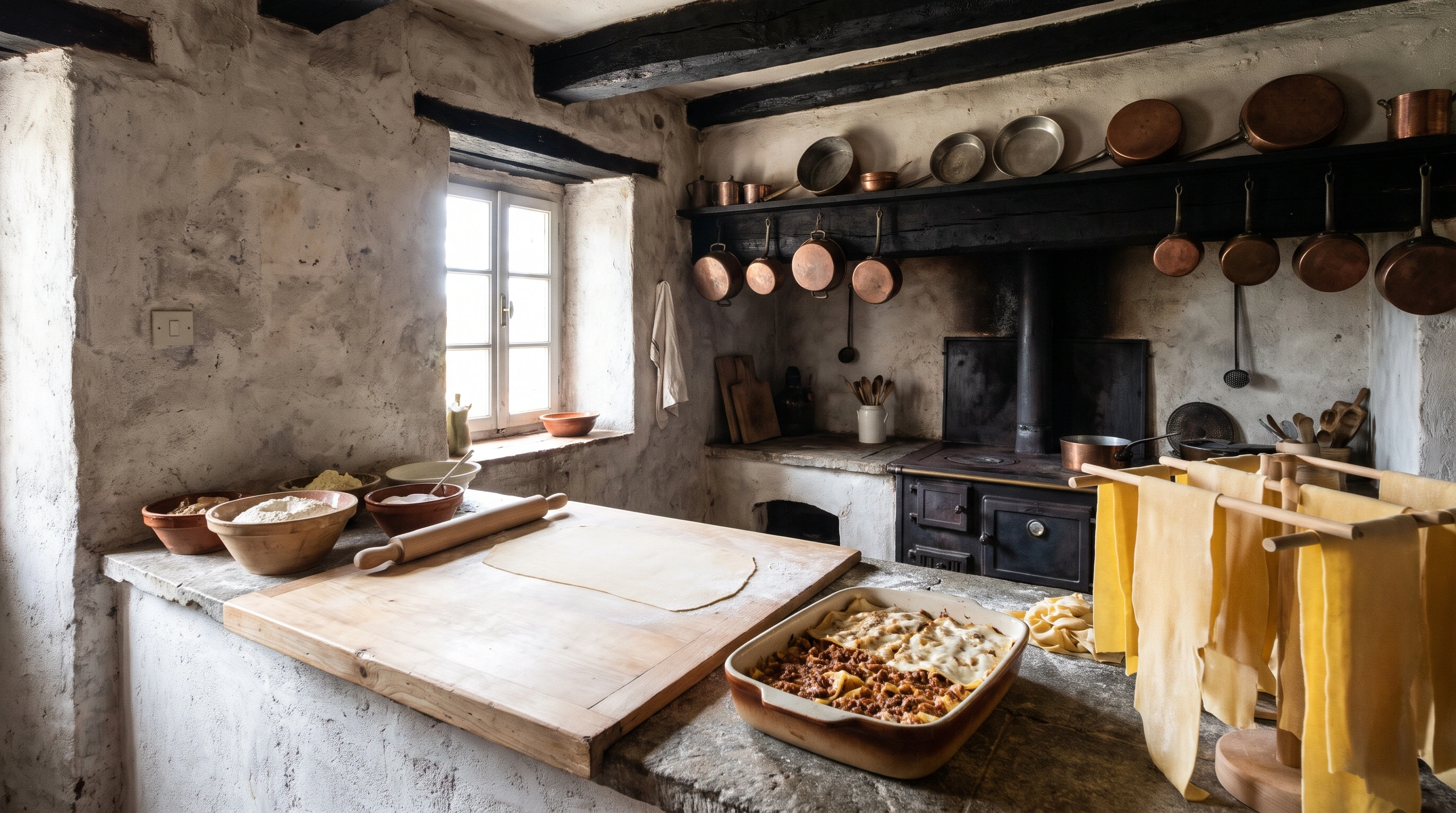
From Ancient Soil to Modern Table
Layered pasta dishes have deep roots in Italian cookery, although the forms recognised as lasagne today developed through regional traditions rather than from one fixed ancient recipe.
The name refers both to the broad sheets of pasta and to the assembled dish. Emilia-Romagna, particularly Bologna, became closely associated with elaborate baked versions prepared for shared meals, feast days and Sunday tables.
Traditional northern Italian lasagne commonly pairs pasta sheets with a slowly cooked meat ragù and a smooth white sauce. Parmesan or another firm grating cheese adds savoury depth between or above the layers. Recipes vary between households: some use fresh egg pasta, while practical domestic versions employ dried noodles; tomato proportions, meats and seasonings also differ. This recipe reflects an adaptable home-cooking style through minced steak, tomatoes, tomato juice, mushrooms and dried herbs.
Béchamel, known in Italian as besciamella, gives the dish moisture and a soft contrast to the pasta and meat. Its preparation by cooking butter with flour, gradually adding milk and melting cheese into the thickened sauce follows a familiar European sauce-making method. Processed cheese is characteristic of economical twentieth-century household recipes, when convenient and readily available ingredients were often incorporated into established dishes.
Lasagne became widely known beyond Italy through migration, restaurants, cookbooks and changing home ovens. English-language recipes frequently adjusted Italian methods to locally available cheeses, packaged pasta and familiar measurements while retaining the defining arrangement of repeated layers. The spelling "lasagna" became especially common in North America, while "lasagne" remained usual in Britain and also represents the Italian plural.
Today, lasagne is valued as a complete, make-ahead dish that can be assembled in an ovenproof vessel and brought directly to the table. Its layered construction makes it suitable for family service, and resting briefly after baking helps the portions hold together. Cream poured over the Parmesan near the end of baking gives this version a particularly rich, browned topping. ■
Login or Register to comment