




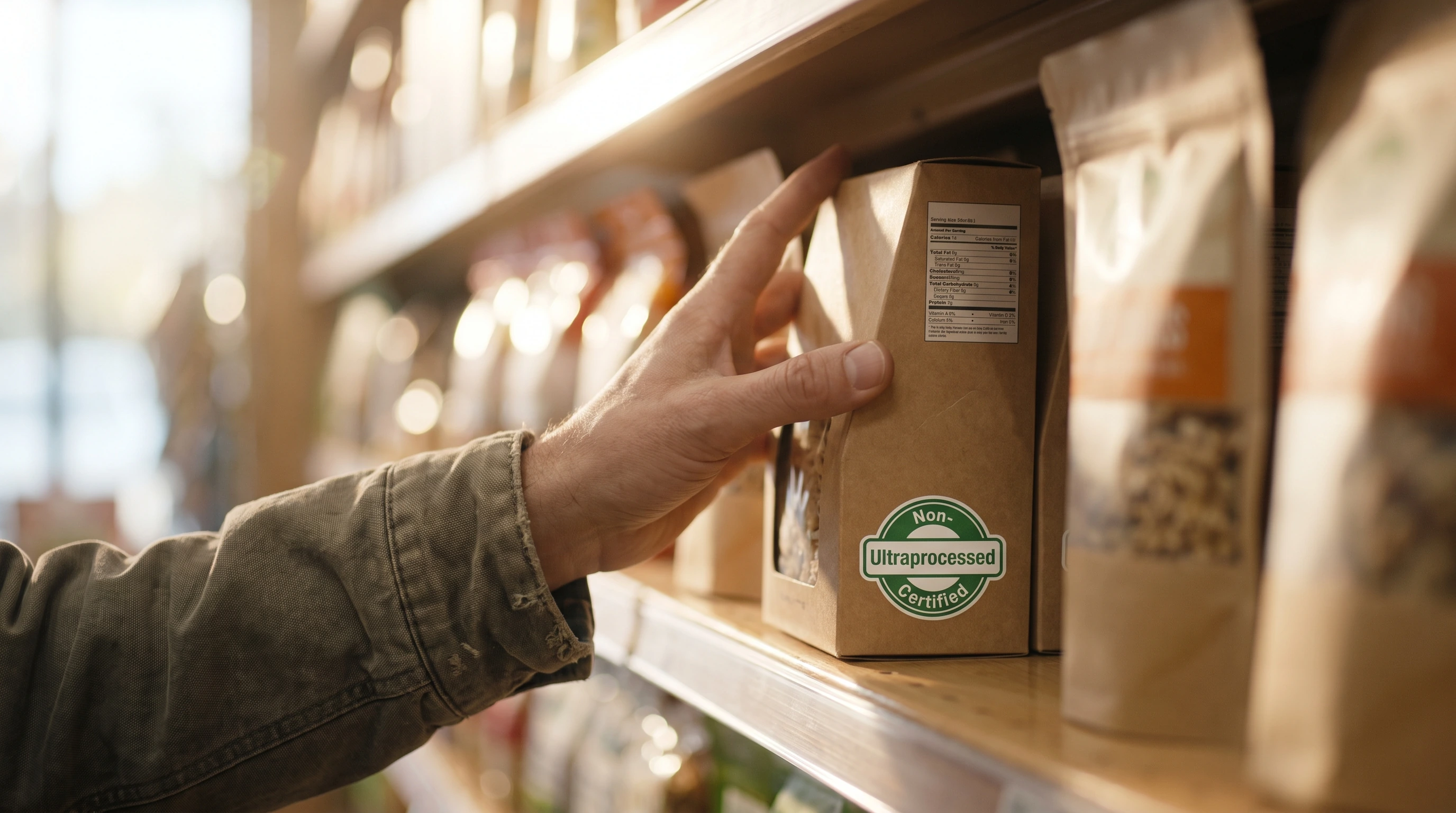
In a California supermarket aisle, the familiar act of turning over a packet may eventually have a new alternative: looking for a seal on the front. Governor Gavin Newsom has signed Assembly Bill 2244 into law, putting the state on course to introduce a voluntary “Non-Ultraprocessed Certified” label for qualifying foods.[1]
The idea is straightforward. Rather than asking shoppers to interpret every ingredient list unaided, the government-backed certification is intended to identify products that meet California’s standard for food that is not ultra-processed. The California Department of Public Health will oversee the system, while certification agents must be ready to certify products no later than 1 June 2028.[1][2]
What earns that mark will matter as much as its visibility. Foods containing certain additives used to enhance taste, texture or palatability, including dyes, flavour enhancers, non-sugar sweeteners and processing aids, will not qualify. The resulting front-of-pack label is intended to make qualifying products easier to identify and more visible on shelves.[1] Participation is voluntary, so the seal will indicate that a product has qualified for certification, not offer a complete description of every unlabelled item beside it.
The law also carries a notable measure of political agreement. Introduced by Democratic Assemblymember Jesse Gabriel of Encino, it received bipartisan support in California’s Assembly and Senate.[3] It follows a 2025 state law, also authored by Gabriel, which created the first legal definition of ultra-processed food in the United States and banned such food from public schools.[3] The new measure moves that policy conversation into the everyday geography of grocery shopping, where a few seconds and a small patch of packaging can shape a decision.
There is still a difficult question behind the apparent simplicity. Critics warn that individual states could develop different definitions while a uniform federal definition remains under development, potentially confusing consumers.[2] California’s seal may therefore become both a practical shopping aid and a test of whether state-led labelling can remain clear beyond state lines.
For now, its promise is modest but recognisable: less deciphering at the shelf and a more direct sign for anyone actively seeking qualifying food. The useful measure of the programme will be whether that small seal makes the choice genuinely clearer when shoppers meet it in the aisle.
Yum Opinion: I like the principle of making labels easier to use, but clarity will depend on definitions that shoppers can trust wherever they buy food.